Seminar 1. Introductions
Seminar 1 · ~77 min · 17 slides
01 · About the instructor — Maxim Nikolaevich Levko
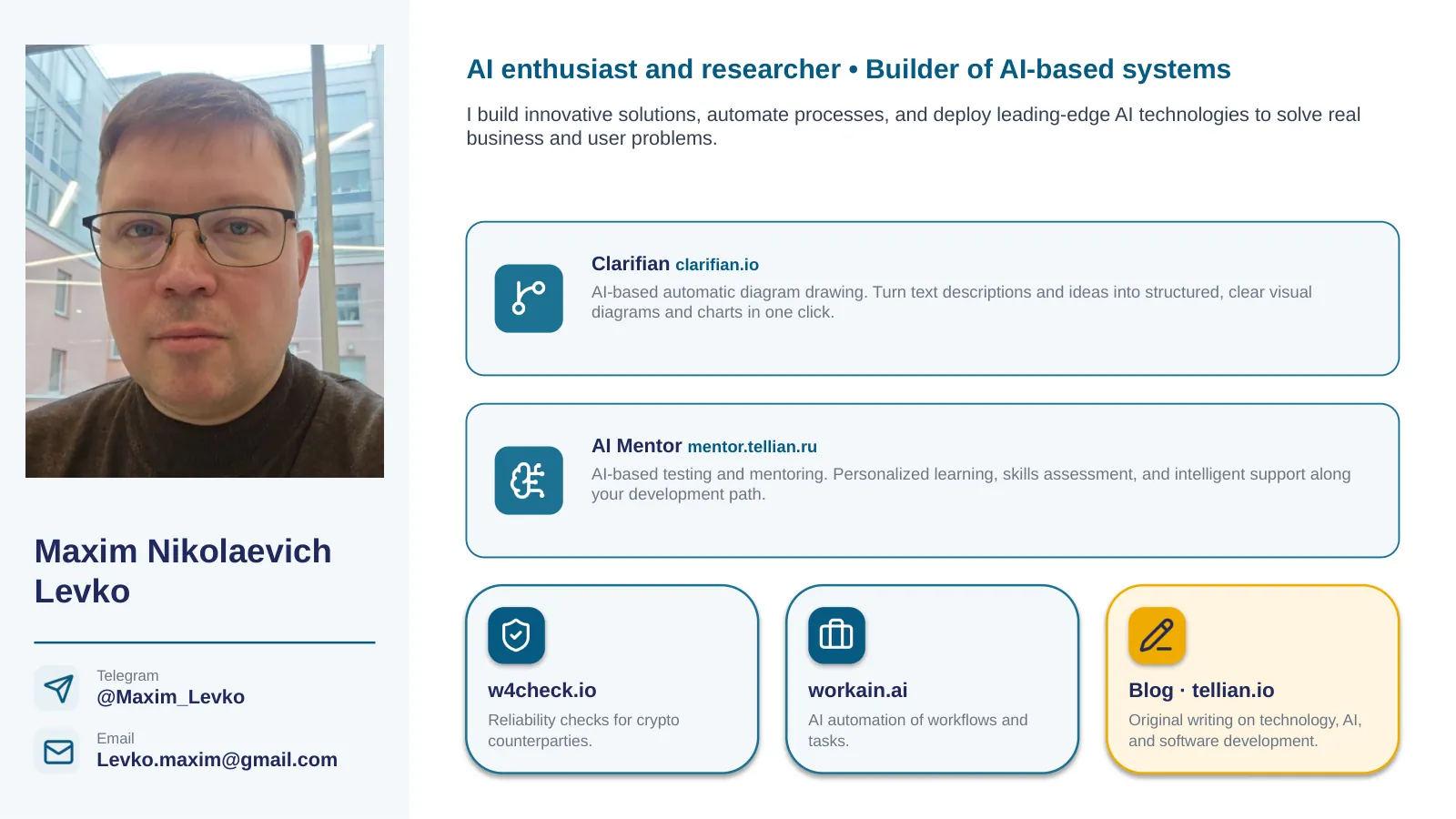
Let me start by introducing myself — here you'll hear about my entrepreneurial side, and in the lecture, about my industry experience.
02 · Warm-up: how do you use AI?
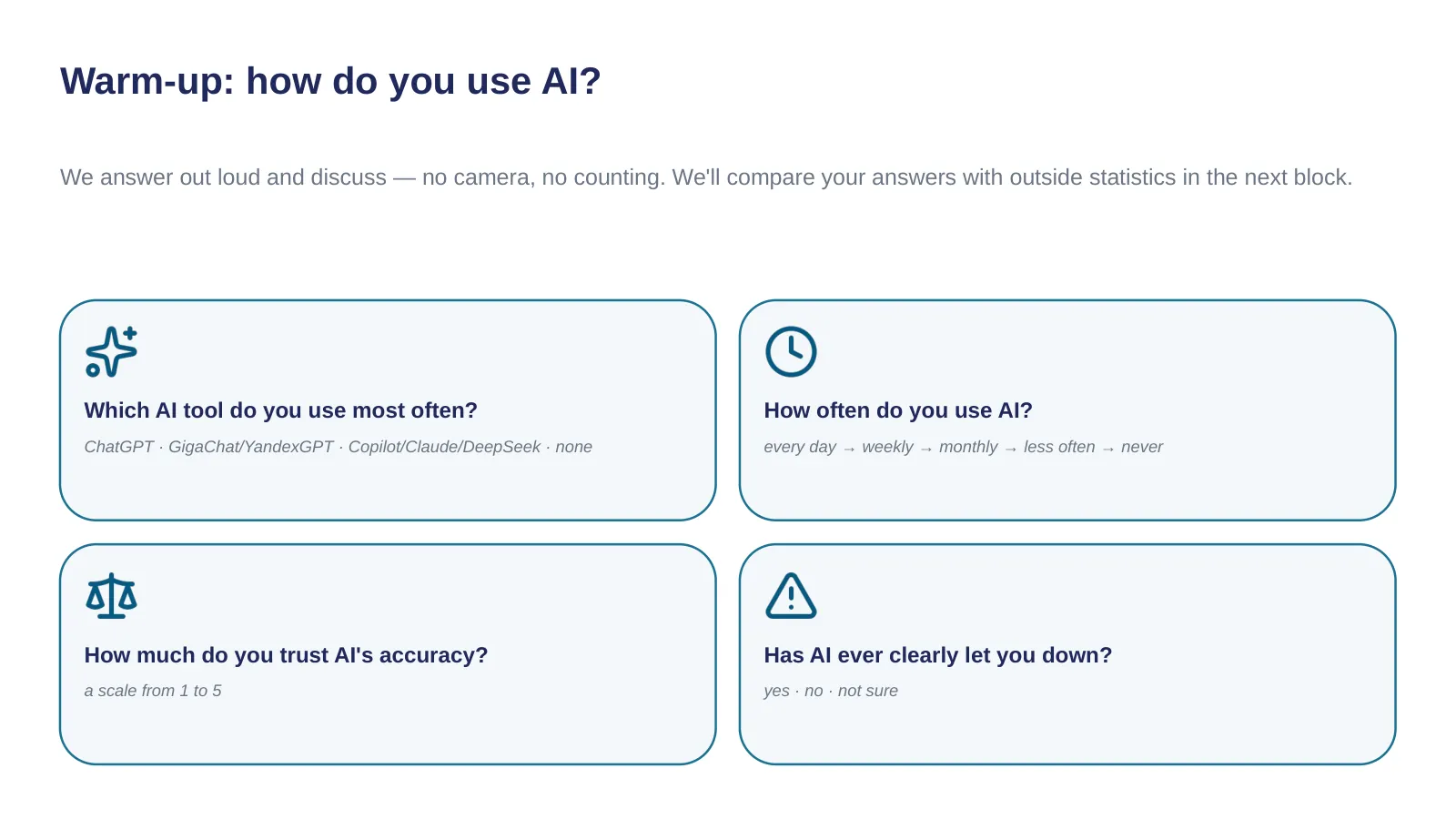
A short warm-up before the statistics — getting a sense of how the group works with AI. Simple format: I ask a question, you answer out loud, and raise a hand if you'd like — this isn't a vote with a camera and a count, it's a live conversation, to get a picture of the group.
Four questions. First — which AI tool you use most often: ChatGPT, GigaChat or YandexGPT, GitHub Copilot / Claude / DeepSeek, or none at all. Second — how often: every day, several times a week, less often, never. Third — how much you trust AI's accuracy, on a scale from one to five. Fourth — whether there's been a case where AI clearly let you down.
We'll need these answers in the next block — we'll compare your group with outside research: whether you're higher or lower on trust, whether you use AI more or less often.
03 · Used more, trusted less — and that's not a paradox
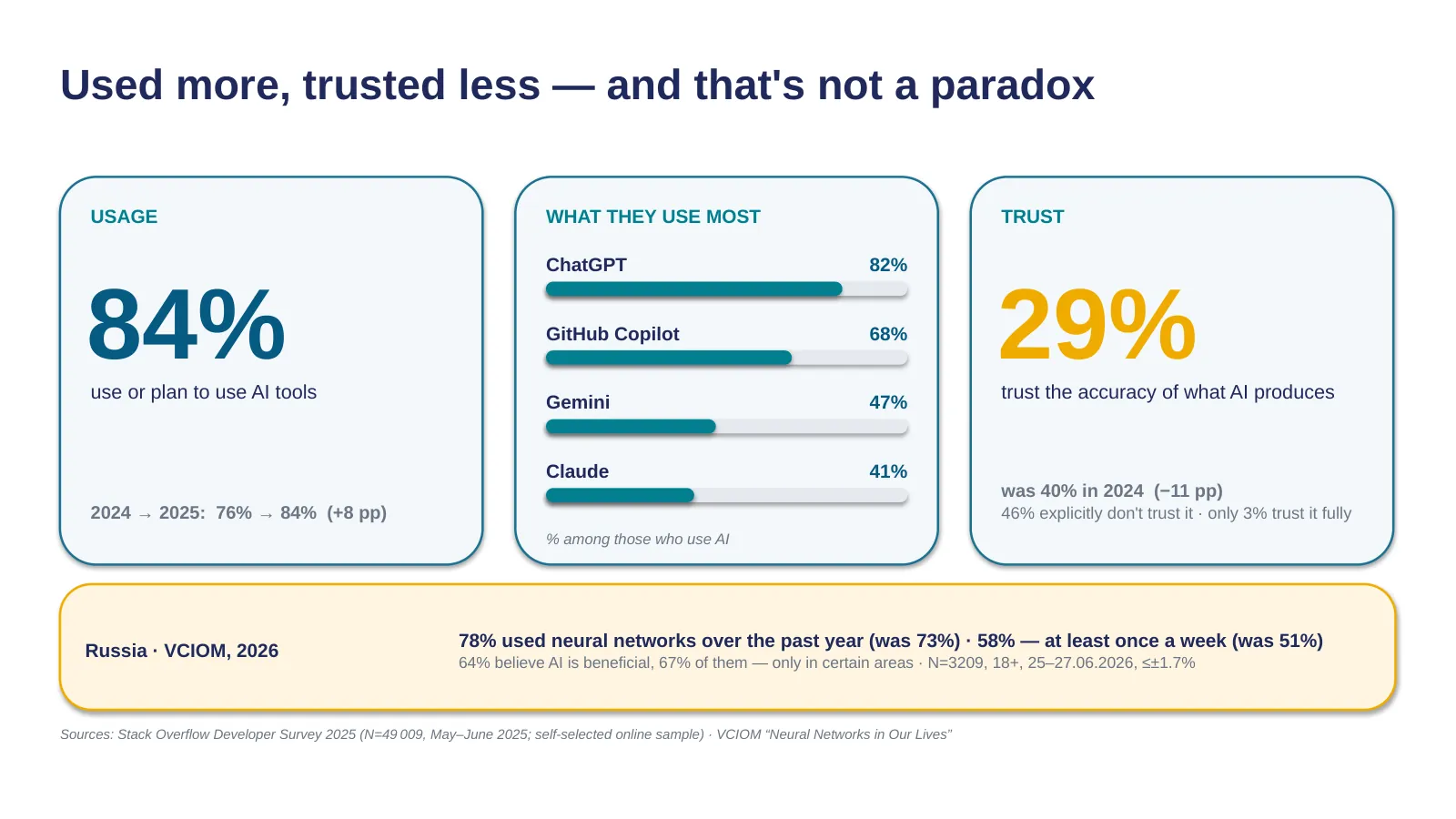
The first source — the Stack Overflow Developer Survey 2025. Eighty-four percent of developers use or plan to use AI tools in development — up from seventy-six percent in 2024. At the same time, only twenty-nine percent trust the accuracy of what AI produces — down from forty percent a year earlier.
How is that possible — using a tool more, but trusting it less? It's not a paradox: the tool is used as a draft that always gets checked — a sign of mature use. An important methodological detail: this is a self-selected online survey — the respondents are people who came to the Stack Overflow site themselves, so the audience skews toward English-speaking developers.
The second source — VCIOM, "Neural Networks in Our Lives." In 2025, seventy-three percent of Russians had used neural networks over the past year, and fifty-one percent at least once a week; the 2026 figures grew to seventy-eight and fifty-eight percent. VCIOM surveys Russians in general, not just an engineering student audience.
The bottom strip — your own numbers from the poll a minute ago, across all four questions. Fill in (verbally, out loud, I'll write it on the slide or record it on the board) the results: which AI tool was named most often, how often the group uses AI, the average trust score on the 1–5 scale, and how many people raised a hand for "AI let me down." How does your group compare with the two outside sources — higher or lower on trust, using it more or less often?
04 · Who has a story — did it help or let you down?
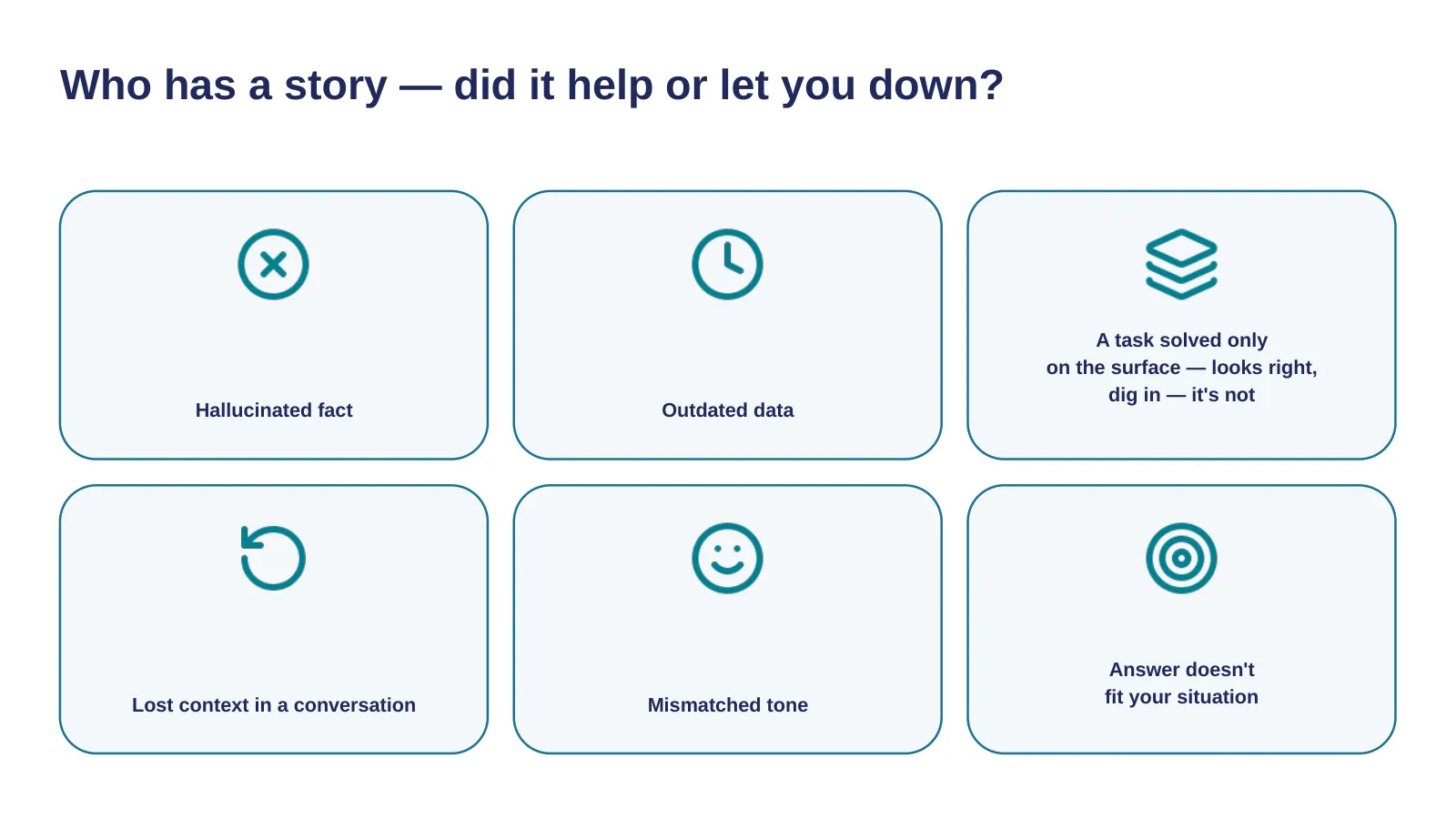
Now — an open exchange of experience in front of the whole audience. In turn, whether by volunteering or by my calling on you, you'll tell one story out loud where AI genuinely helped, and one where AI let you down or made a mistake. Together, on the board, we'll find common patterns in the stories we collect.
Whoever has a story where AI genuinely helped — raise a hand. If no one volunteers right away, that's fine, I can call on someone directly. We'll alternate: one success story, then a failure, then a success again — that way we keep the balance and don't let the conversation slide into one tone.
Six categories of AI failure that come up most often: a hallucinated fact — AI confidently makes up a fact or source that doesn't exist; outdated data — AI answers with information that was correct at training time but is now stale; a task solved only on the surface — the result looks like the right answer, but on inspection the substance isn't actually solved (this is broader than just code: the same pattern shows up in text and in calculations too); losing context in a long conversation, where AI forgets the conditions set at the start; a mismatched tone or style in the response; and too-generic advice — AI gives an answer that's correct in general but nonspecific, and it doesn't account for your particular situation. When you tell a failure story, try to guess for yourself which category it belongs to — we'll pin it down together. Failure stories in particular are valuable today: they help reveal AI's real limits, not just its impressive examples. This same term — hallucination — will come back with a precise definition later, in the quickfire quiz.
— Instructor's personal stories (to tell in this block, one per category) —
-
Hallucinated fact. Last year, while I was writing an article for a conference, a model gave me several citations to research papers that don't exist — and some of the citations pointed to real papers, but on a completely different topic than claimed. It looked confident and plausible, so every citation had to be checked by hand.
-
Outdated data. This is especially noticeable in development: a model pulls in outdated library versions and, worse, outdated approaches. For example, you ask for a React component — and it writes it as a class with componentWillMount instead of hooks; or it suggests moment.js, which hasn't been actively developed in years, instead of date-fns or the built-in Temporal. The code is formally working, but the approach is from the day before yesterday.
-
A task solved only on the surface. This happens with almost every product I build: the first AI prototype looks a lot like what's needed — screen, buttons, responses — but dig in, and often it either doesn't work or fakes working (data is hardcoded, error handling is drawn but not wired up). A finished product on the outside, a stage set on the inside.
-
Lost context. In a long refactoring conversation, after a couple dozen messages, the model forgets what we agreed on at the start: say, I explicitly said "no pulling in external dependencies" and we renamed a module — and twenty replies later it's suggesting a third-party library and the old name again, as if the conversation never happened. The context has drifted out of the window, and the conditions have to be restated.
-
Mismatched tone. The example is right in front of you — these lectures. I prepare them with heavy AI involvement, and there are still odd turns of phrase and tone on the slides and in the notes that I haven't cleaned up. This is an honest example that a model's tone has to be edited by hand.
-
An answer that doesn't fit your situation. The same story keeps coming up for me — a model's paranoid "information security" on dev and test environments: it resists saving or showing the logins and passwords for test users because "that's not secure," even though we're talking about deliberately fake test accounts on a local environment, which is exactly where that's needed. The advice is correct in general — just not for my particular situation.
05 · Who wrote it — fiction: AI or human?
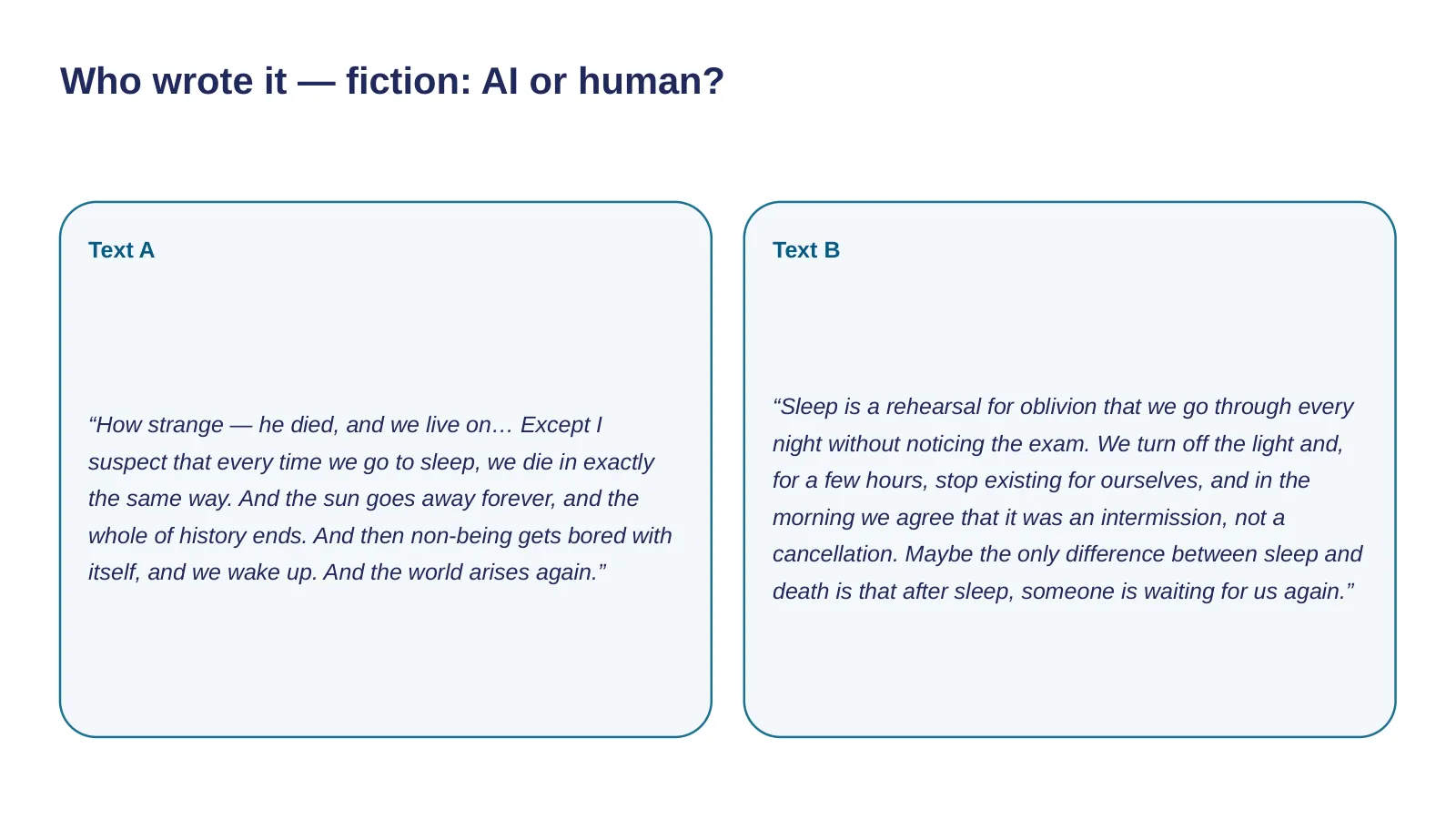
The first category in the calibration game — fiction. Two short fragments on the theme of sleep and reality, unlabeled. Let's vote: which one was written by a human, which by AI.
Both texts are deliberately similar in theme and tone — the point isn't to find an obvious difference in subject matter, but to hear a difference in style, if one is even noticeable in such a short fragment.
After the vote — ask one or two students what tipped them off: the rhythm of the sentence, characteristic turns of phrase, a recognizable voice? For fiction, there's no objective, measurable criterion for "which is better" — this category is about style and recognition, not about productivity.
06 · Text A — Pelevin, "Generation P". Text B — AI
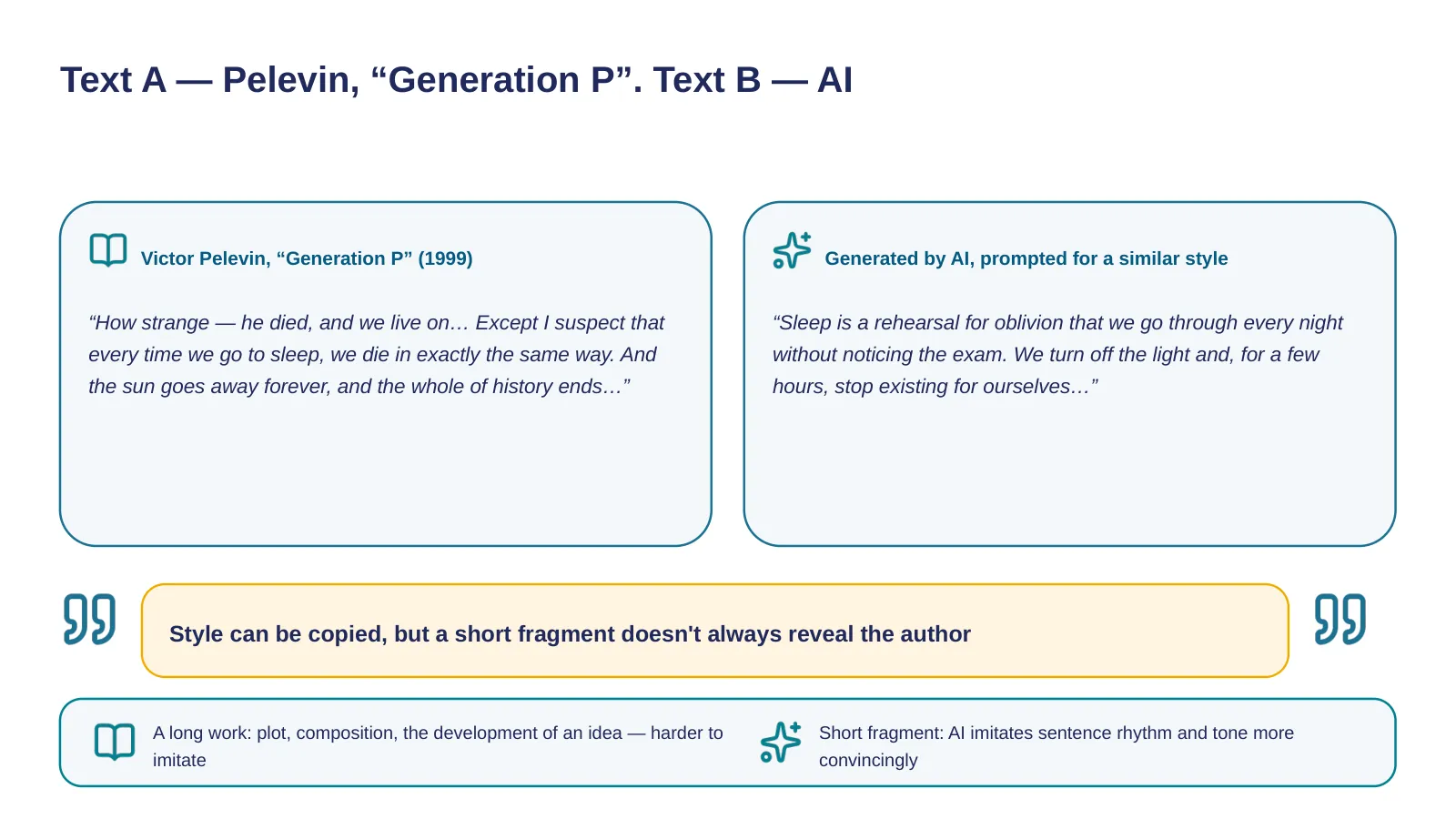
Text A is a real quote from Victor Pelevin's novel "Generation P," 1999. Text B was generated by AI, prompted to approximate a similar philosophical-reflective style on the theme of sleep and reality.
On such short fragments, modern models really can do a decent job imitating a recognizable manner of writing — the rhythm of the sentence, characteristic constructions. That doesn't mean AI "writes like Pelevin" in any broad sense — reproducing style over two or three sentences and writing a whole work with an original idea are tasks of very different difficulty. The lesson of this round: a short stylized fragment is an unreliable test for determining authorship, especially in fiction.
07 · Who wrote it — technical text: AI or human?
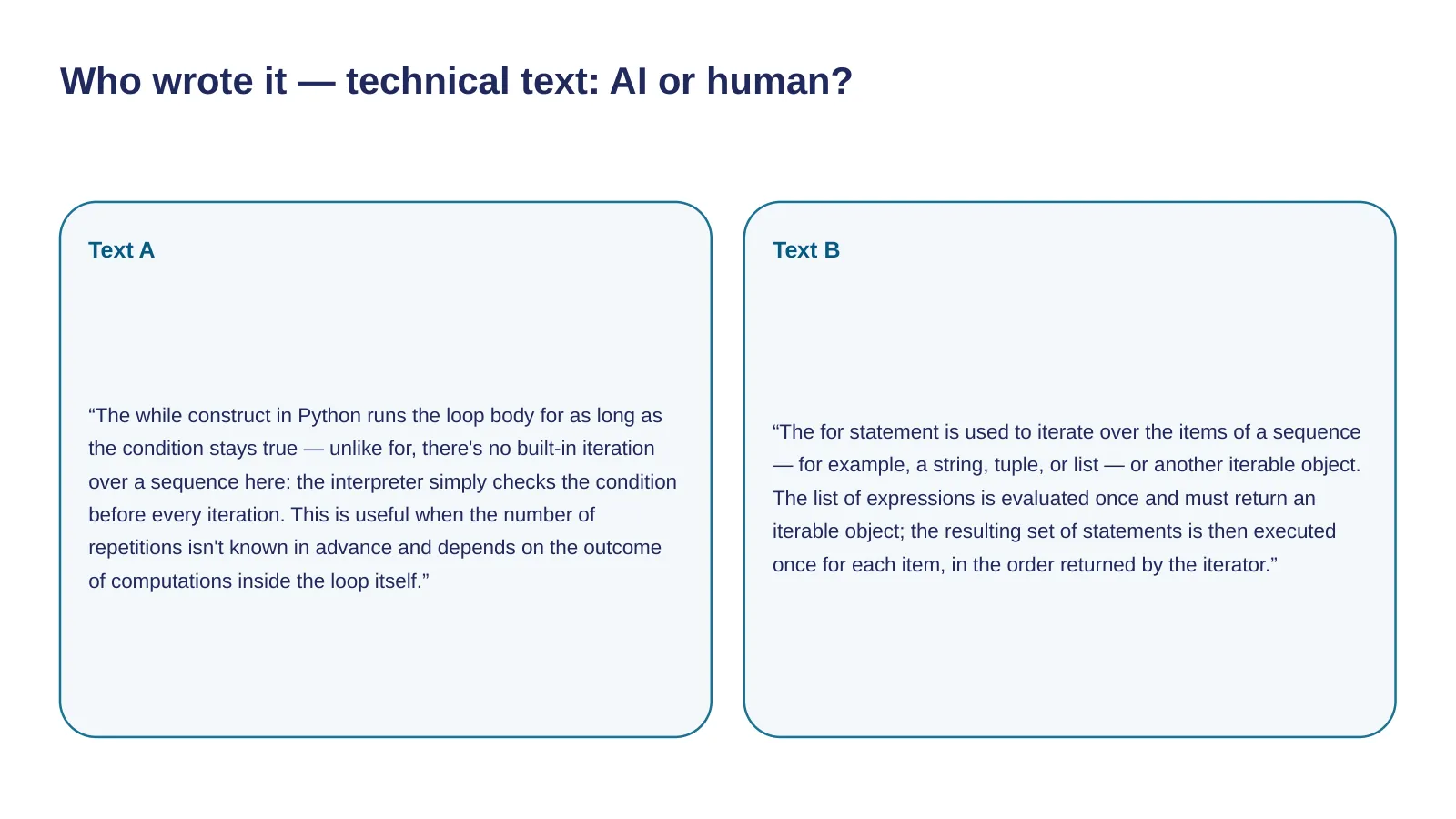
The second category — technical text, documentation. Two fragments explaining the behavior of a language construct. Let's vote: which was written by a human, which by AI.
Beyond the question of "who's the author," let's discuss another one: in what way, and how measurably, does the AI version differ in practical usefulness from official documentation? Not just "who wrote it," but also "what it means for someone looking for an answer right now."
After the vote, ask: what tipped you off — the precision of the wording, a characteristic structure that explains through comparison with other languages?
08 · Text A — AI, in seconds. Text B — official Python documentation
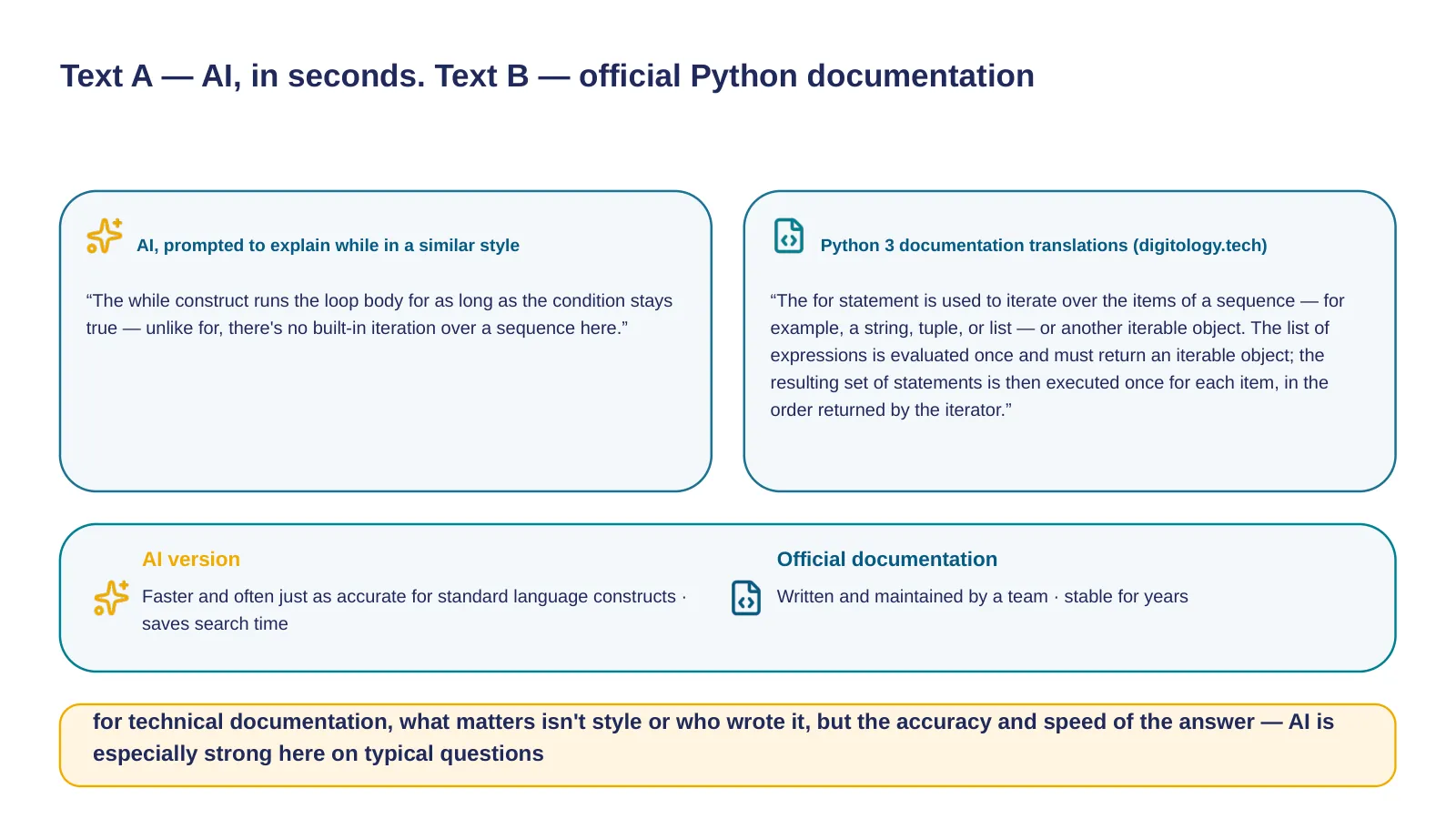
Text A was generated by AI, prompted to explain while in documentation style. Text B is an exact quote from the official Russian translation of the Python 3 documentation ("Python 3 Documentation Translations," digitology.tech), section "8.3. The for statement."
What matters here isn't just the question of authorship, but an honest comparison: official documentation is written and maintained by a team, goes through review, and is stable for years. But for standard language constructs like for and while, the AI version is often just as accurate — and you get it in seconds, without having to search for and read through the whole documentation.
Lesson: for technical documentation, what comes to the fore isn't who wrote it, but the accuracy and speed of getting an answer. On typical, well-documented questions — language syntax, standard constructs — AI is especially strong precisely because that information is described, repeatedly and consistently, in its training data.
09 · Who wrote it — code: AI or human?
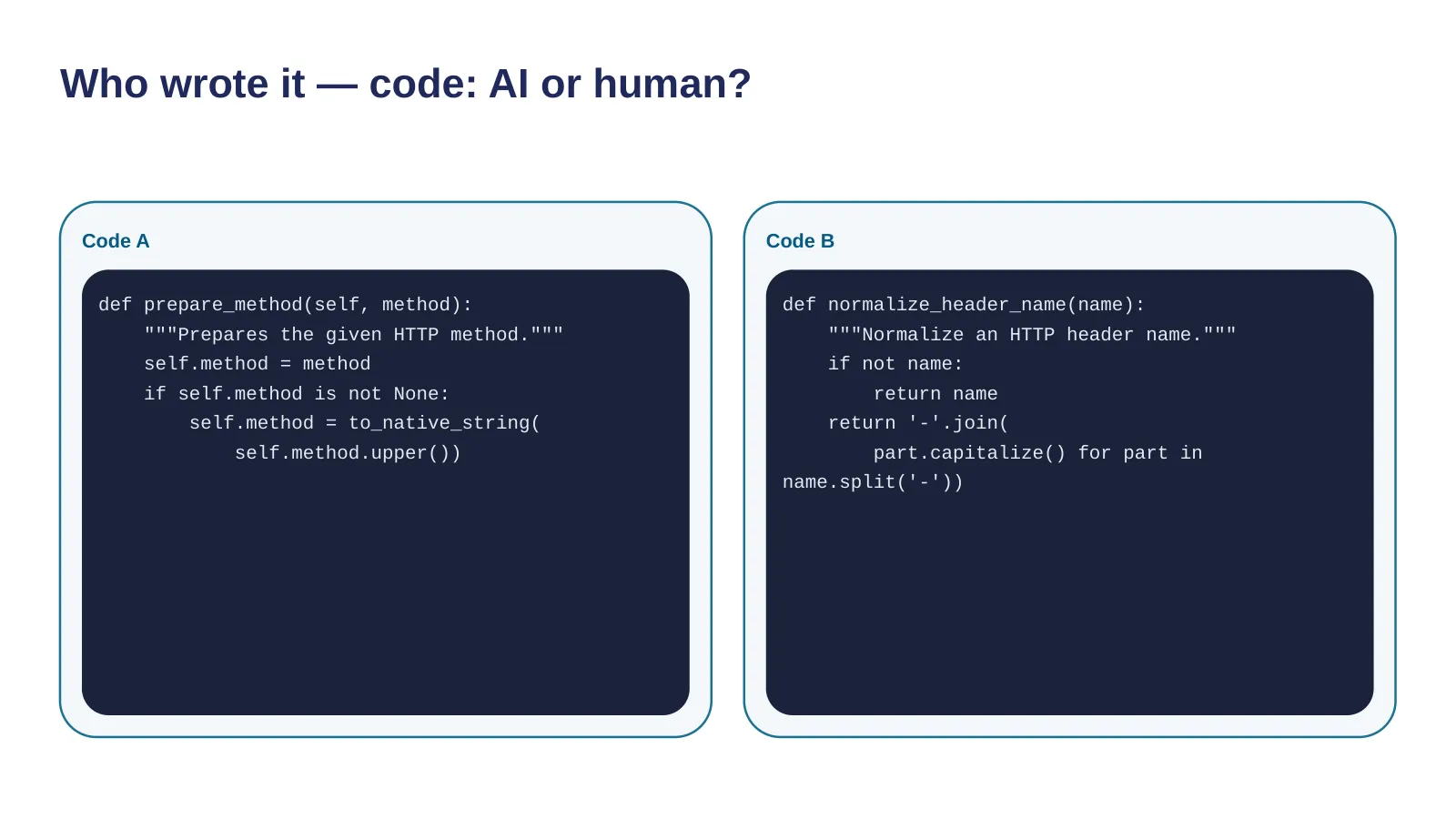
The third category — code. Two small functions, roughly the same scale. Let's vote: which was written by a human, which by AI.
Here too, it's not just about authorship: what's the measurable difference in productivity between "get a function from AI" and "use a proven library"? We'll discuss this in the reveal.
After the vote, ask: what tipped you off — the variable-naming style, the docstring, the structure of the conditional check?
10 · Code A — the requests library, 10+ years in production. Code B — AI, 10-20 seconds
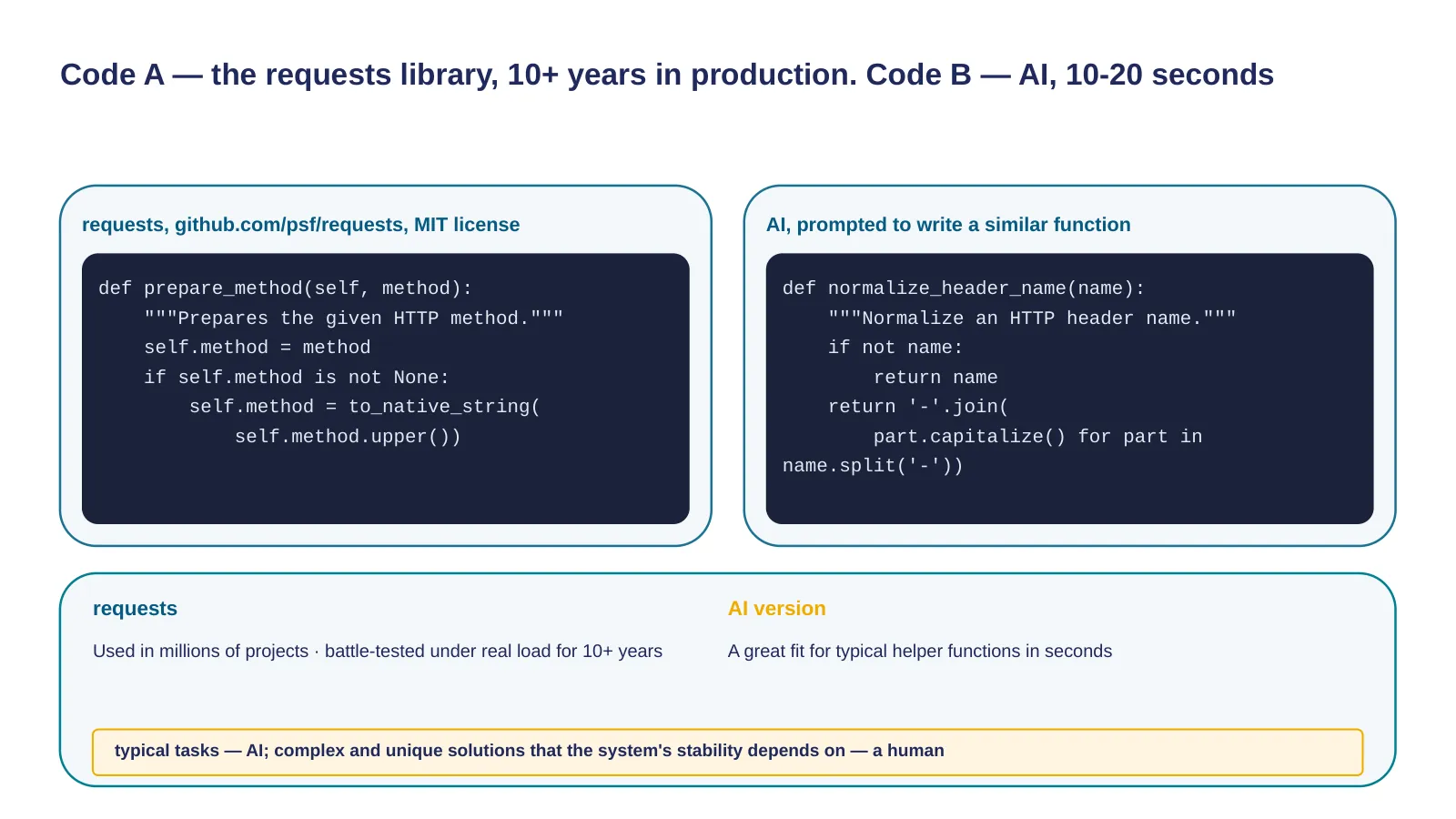
Code A is a real function from the requests library, one of the most-used Python libraries, open source on GitHub, MIT licensed. Code B was generated by AI on a similar prompt — write a small function of similar scope.
An honest comparison, without putting down either side: requests is code that's been running in thousands and millions of real projects for over ten years — every hidden bug has most likely been found and fixed by the community by now, the result of years of testing under complex, high-load infrastructure. You get the AI version in 10–20 seconds — a great option precisely for typical helper functions like this, boilerplate code, one-off scripts.
This round's lesson isn't "AI is worse" — it's a split by task type: typical, helper tasks — AI, it's faster and reliable enough. Complex and unique solutions, architectural, high-stakes ones that a system's stability depends on — a human, with their experience and accountability for the decision.
11 · Who made it — a painting: AI or human?
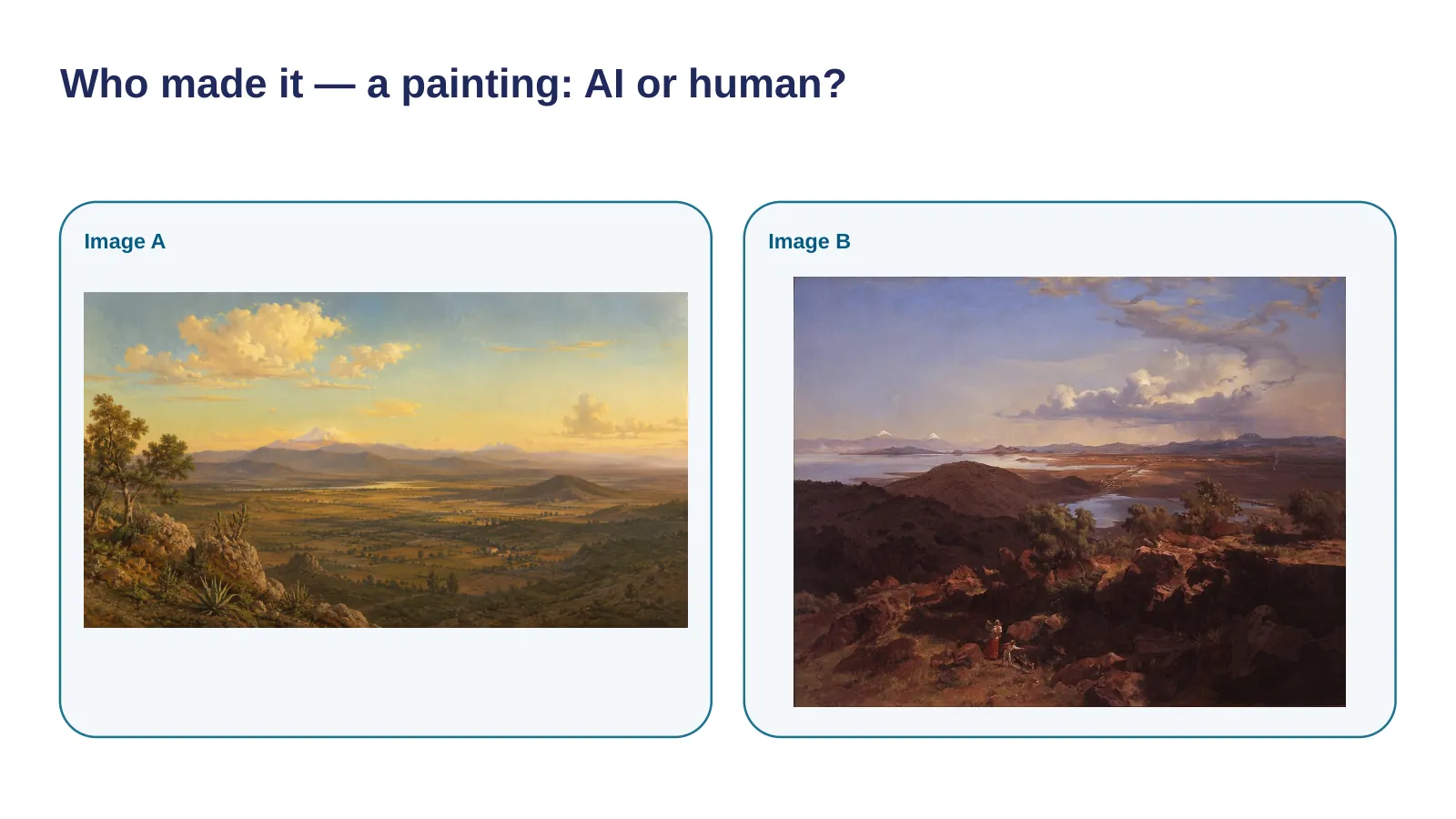
The fourth category — an image. One of the two cards is a real painting, the other shows a stylized example of what AI might generate on a similar prompt.
This category is about style and perception, not measurable productivity: modern image-generation models really can imitate recognizable artistic styles in seconds, but the question isn't "which is faster," it's "what are you actually looking at, and how do you tell the difference."
After the vote, discuss: what visual cues give away the human hand — light, composition, small imperfections? Modern generative models are getting more and more convincing precisely at stylizing to match specific artists.
12 · Image B — José María Velasco, 1875. AI would generate something similar in seconds
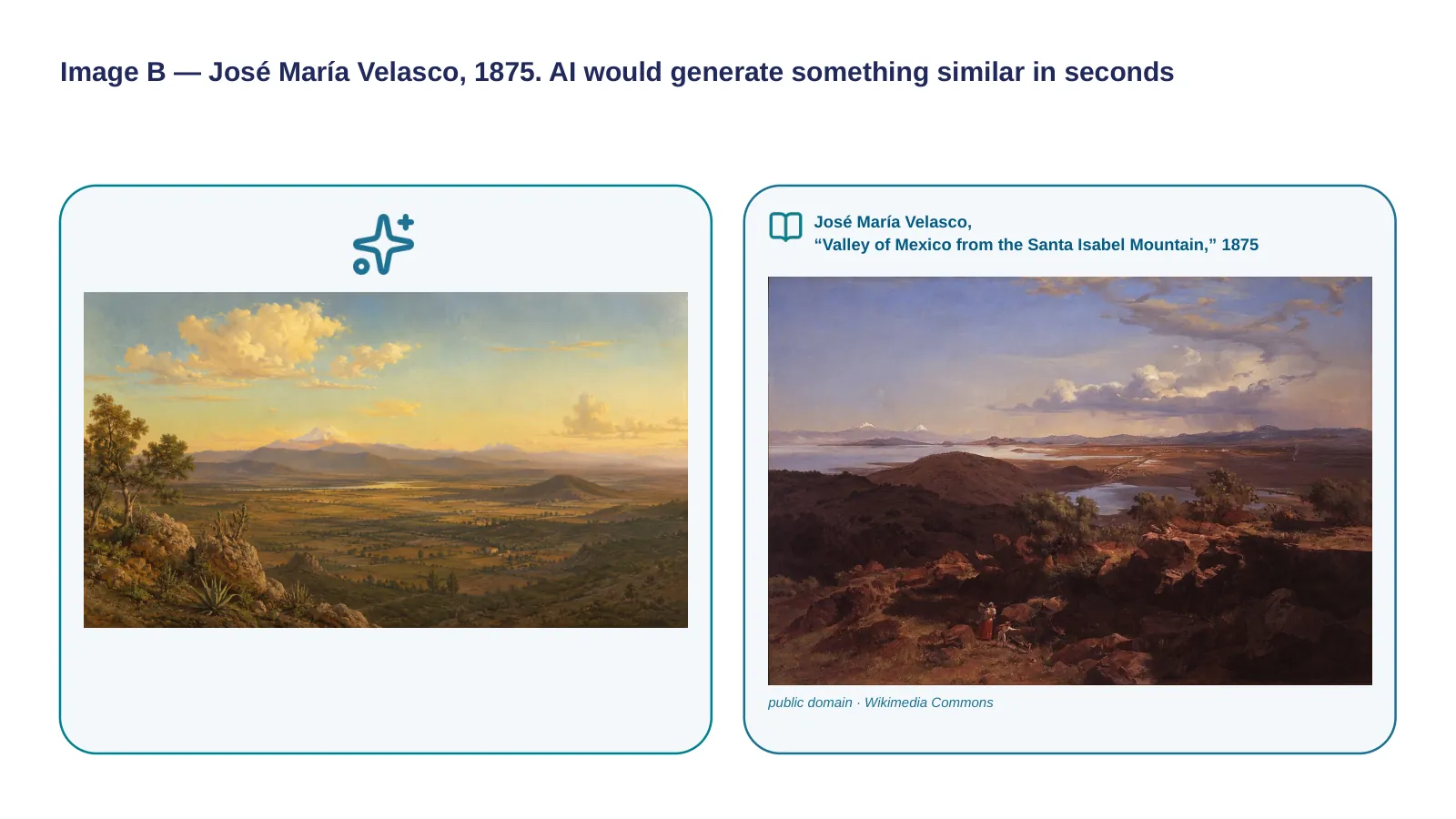
The real painting is "Valley of Mexico from the Santa Isabel Mountain," 1875, by José María Velasco — a 19th-century Mexican landscape painter, and one of the most famous panoramas of the Valley of Mexico in the history of Latin American painting, now in the public domain.
On a similar text prompt — "a valley panorama, distant mountains, volcanoes on the horizon, warm evening light, 19th-century landscape painting style" — a modern image-generation model would produce a composition similar in spirit within a few seconds. We're not showing an actual generated file here — we're being upfront that this is a hypothetical example, not passing off our own description as a real result.
The lesson of this round: AI can imitate a recognizable style quickly and convincingly, but behind that speed there's no creation history, no artistic intent, no authenticity of the moment — the commercial or artistic value of the original isn't built on visual resemblance alone. Unlike technical text or code, the question here isn't about reliability, but about ethics and the authenticity of authorship.
13 · Who made it — a data visualization: AI or human?
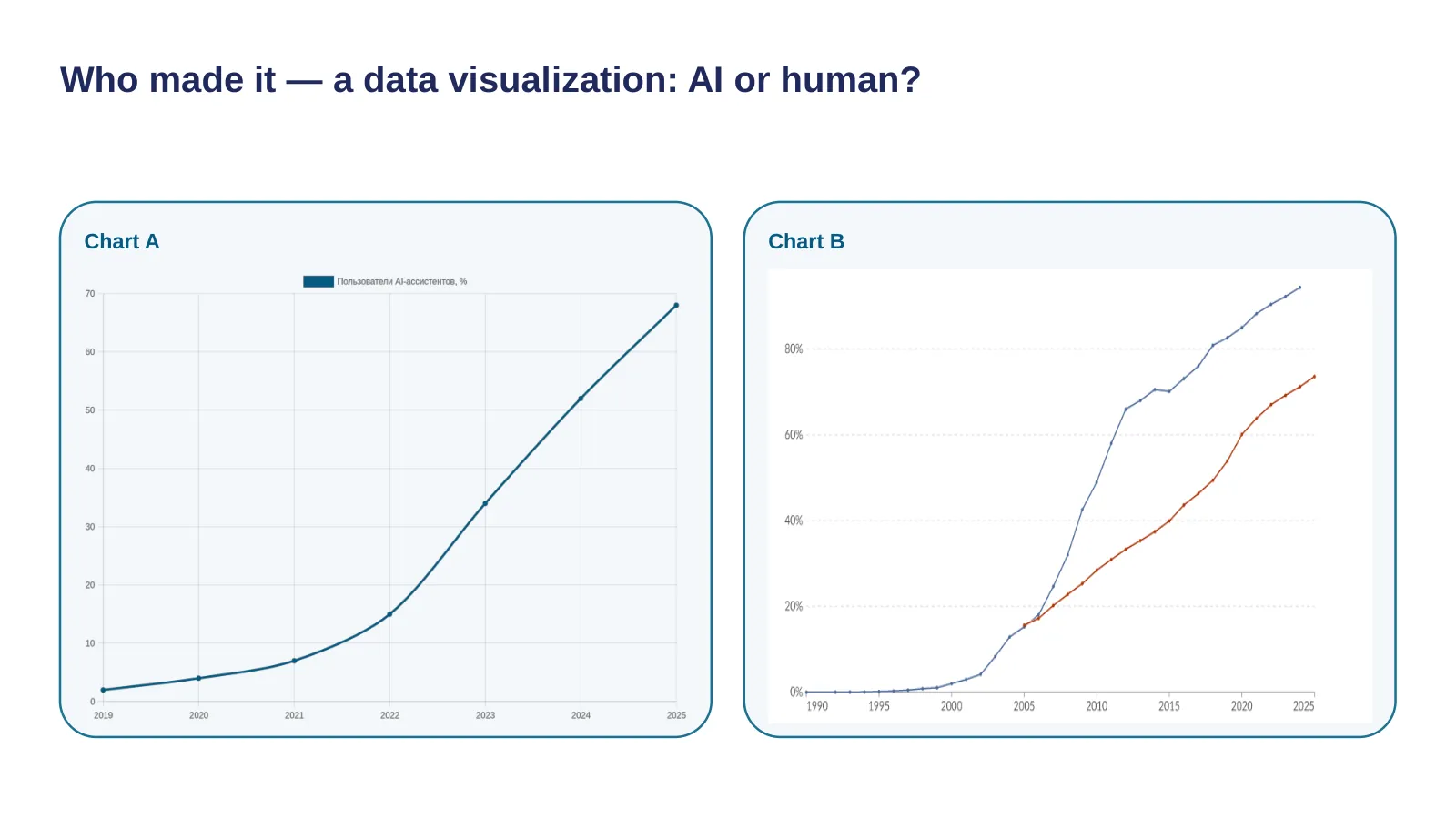
The fifth category — data visualization. Two charts of a similar format — a line showing a metric's growth over the years. Let's vote: which is based on real research, which is generated from fabricated data.
Here again the focus is on the measurable payoff: not just "which chart looks nicer," but "which of the two can you trust, and why." On the surface, two neat line charts are almost indistinguishable — that's deliberate: the indistinguishability itself is the lesson.
After the vote, ask: what could actually tell apart a chart built on real data from a plausibly drawn one — the data source, a methodology note, or nothing at all, if the presentation is equally polished?
14 · Chart A — AI, seconds. Chart B — Our World in Data, weeks of verification
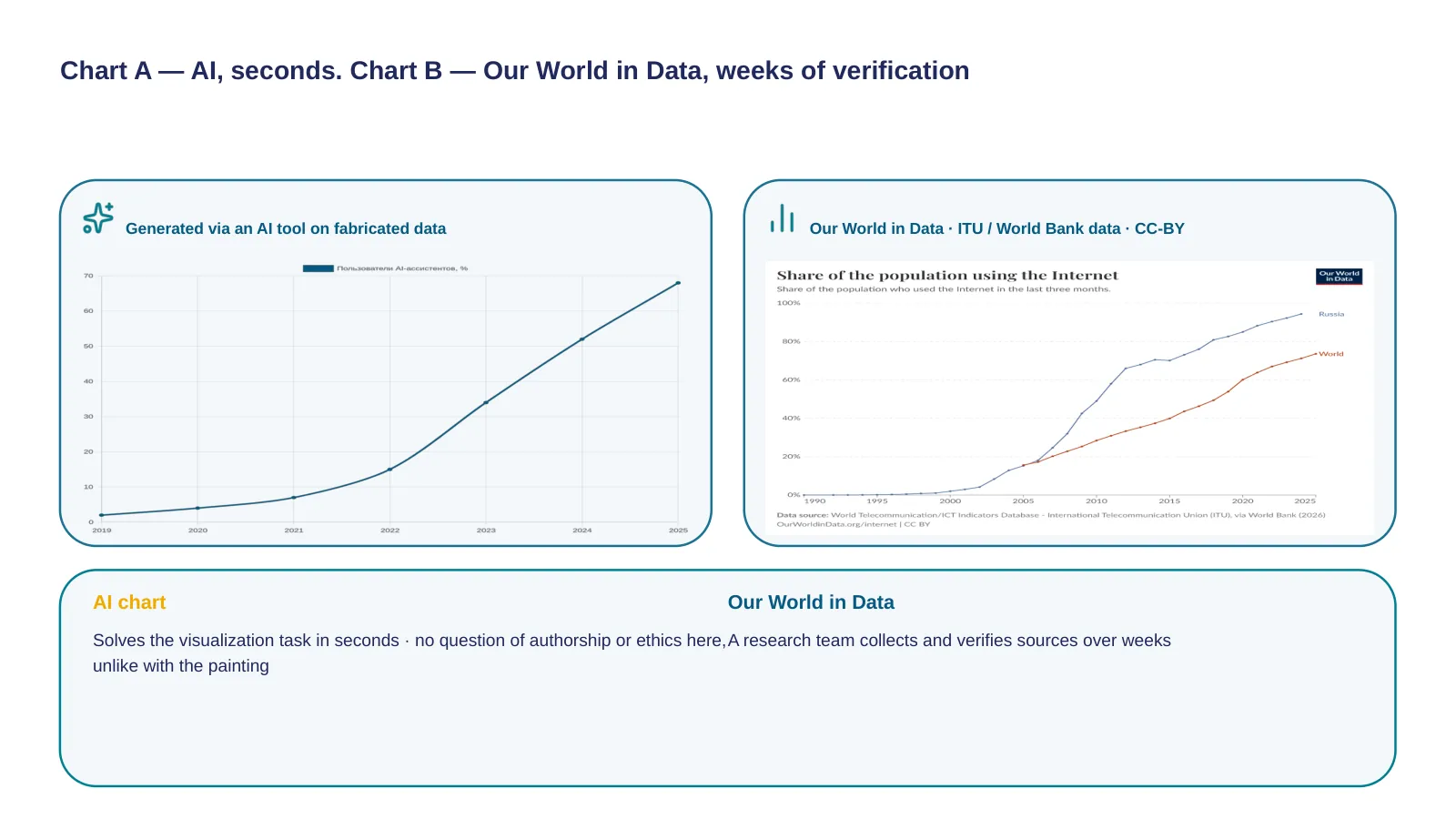
Chart A was generated by us via an AI tool on plausible but fabricated numbers — specifically for this game. Chart B is real Our World in Data data on the share of the population using the internet, Russia and the world, sourced from the International Telecommunication Union via the World Bank, CC-BY licensed.
An honest comparison: an AI tool solves the data-visualization task in seconds and does it well — unlike the "painting" category, there's no question of authenticity or artistic intent here; visualization is a purely technical task. The only question that matters is where the data came from and how reliable it is. Our World in Data is built by a research team that spends weeks collecting, cross-checking, and re-verifying data sources before publishing a chart.
This is the main lesson of the whole game: the neater the visual presentation, the less it says on its own about the reliability of the data inside it. Form and content are separate questions: AI solves the question of form excellently and quickly, but the question of content — where the data comes from and how real it is — is still a human's responsibility.
15 · True or false? Let's check your intuition about AI
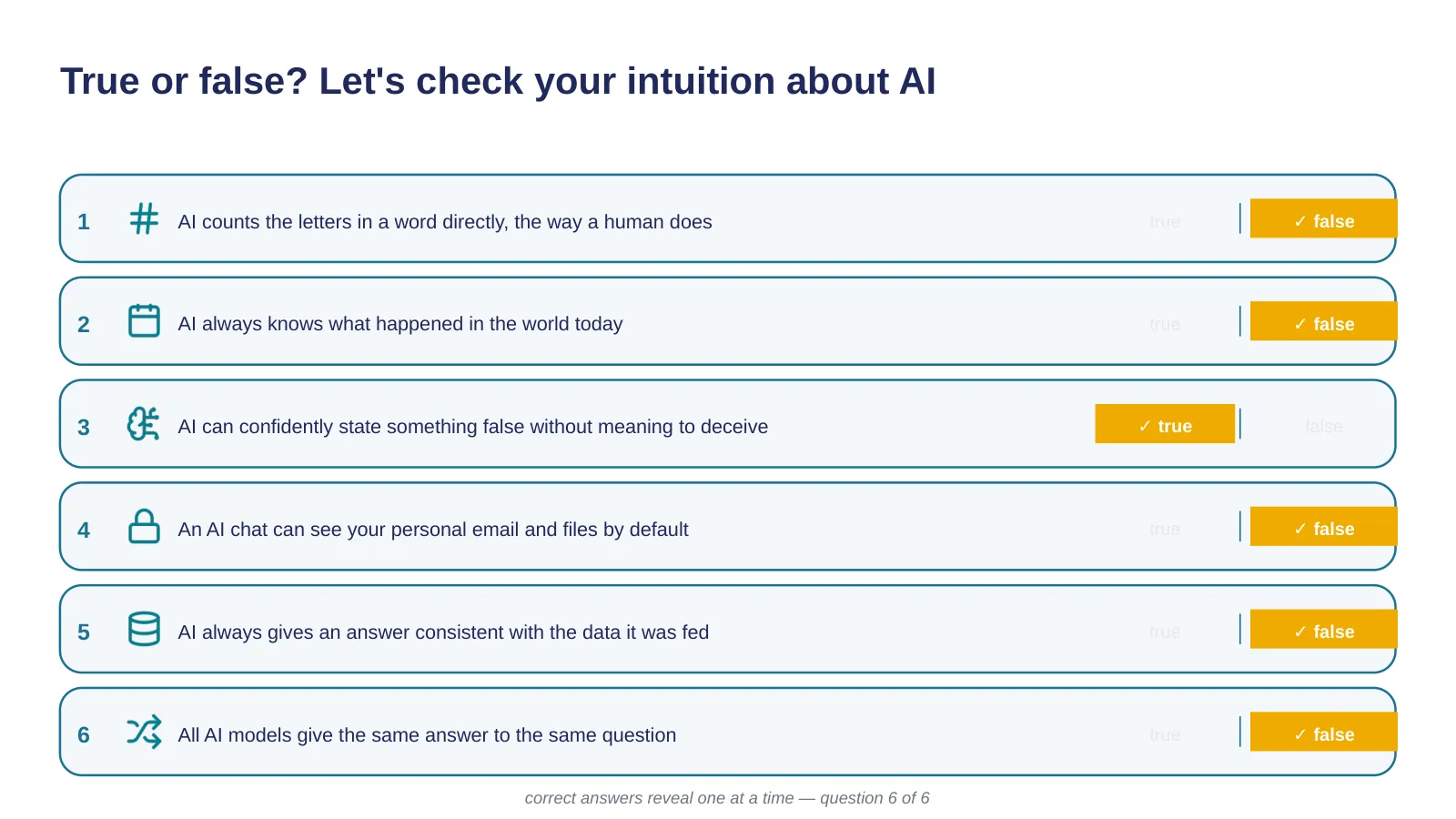
Quickfire quiz: I read out a statement, you vote by raising a hand — true or false — before I give the answer. The explanation will be short, with a lesson, not just a bare fact.
First: AI counts the letters in a word directly, the way a human does. False — AI splits text into tokens, it doesn't read letter by letter.
Second: AI always knows what happened in the world today. False — the model is trained on data up to a certain cutoff date and, without web search, doesn't know about events after that.
Third: AI sometimes confidently and convincingly says something untrue, without even intending to deceive. True — this phenomenon is called hallucination, we already discussed it in the previous block under the name "hallucinated fact." A confident tone in an answer isn't a sign of accuracy.
Fourth: an AI chat can see your personal email and files by default. False — without an explicit connection, AI has no access to personal data.
Fifth (a new statement in round-2): AI always gives an answer consistent with the data it was fed. False — training data really does shape the model's "character" and its systematic biases, but the answer isn't derived from it rigidly and unambiguously. Because of the randomness of sampling (temperature), the same model can give different answers to the same question. The model doesn't "look up" a ready-made chunk of text in the training set — it generates a continuation based on learned statistical patterns, which is why both generalization to new cases and hallucinations are possible. On top of that, a model's behavior is heavily adjusted after pretraining — through fine-tuning and dialogue tuning (RLHF), so the final answer reflects more than just the "raw" training data.
Sixth: all AI models give the same answer to the same question. False — different models, and even the same prompt run multiple times, can produce answers that differ in substance. Cross-checking with several sources is sensible for important decisions.
On the third and fifth questions the audience usually splits almost evenly — if you see a split, ask a couple of people from each side why they voted that way before giving the answer.
16 · The "AI reality-check" memo — 5 points to carry into the next week
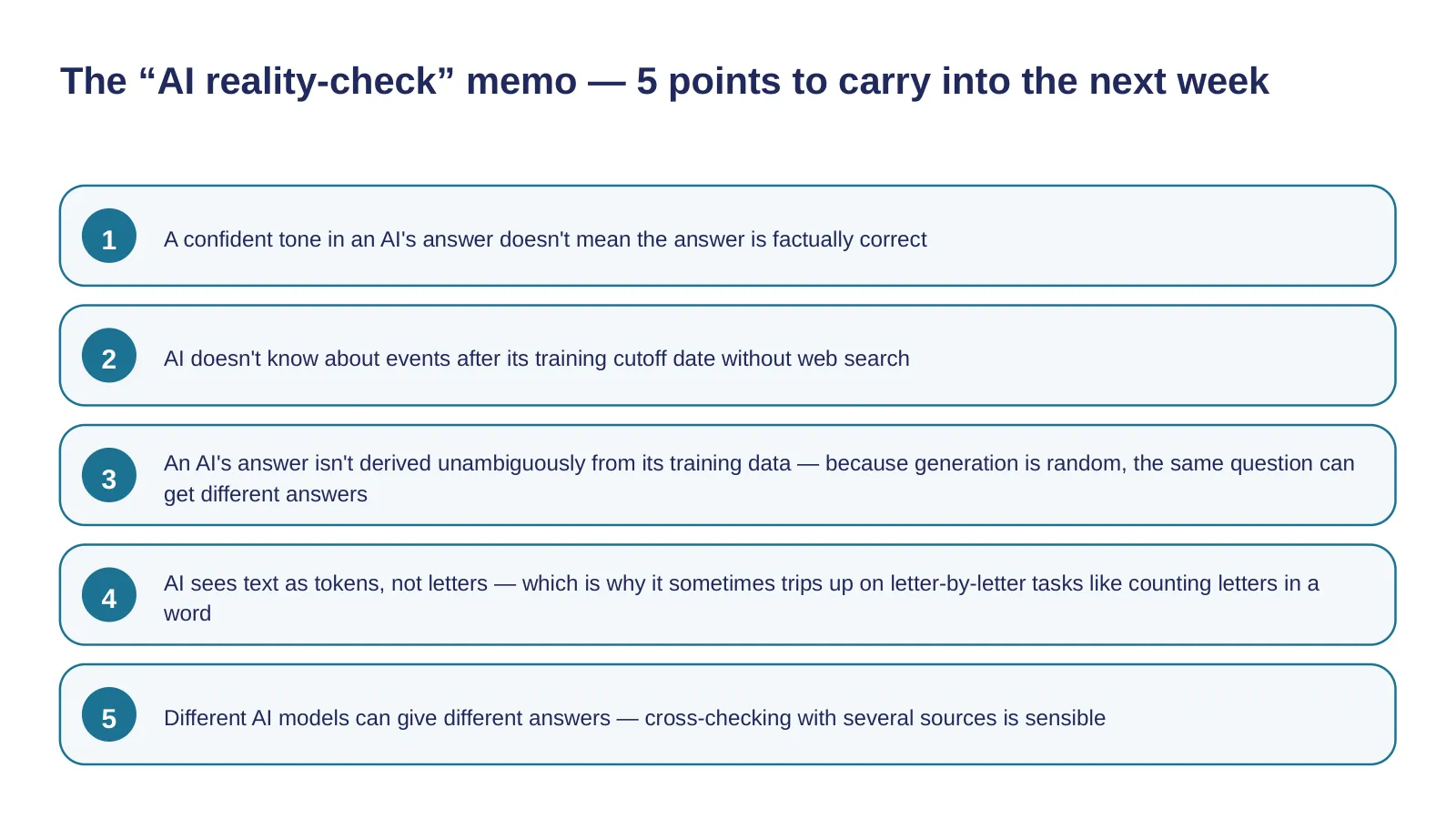
Here's the "AI reality-check" memo — five points that will come in handy this very week, drawn from today's quiz.
First: a confident tone in an AI's answer doesn't mean the answer is factually correct. Second: AI doesn't know about events after its training cutoff date without access to web search. Third: an AI's answer isn't derived unambiguously from its training data — the model doesn't "look up" a ready-made chunk of text in the training set, it generates a continuation based on statistical patterns, and because sampling is random, the same question can get different answers. Fourth: AI sees text not as letters, but as tokens — chunks of several characters — so on tasks that require counting letter by letter (say, how many "r"s are in a word), the model can make mistakes, even though overall it works with language extremely well. Fifth: different AI models can give different answers to the same question — cross-checking with several sources is sensible for important decisions.
Take this sheet with you. These five points will be useful not only in this course, but in any work with AI tools.
17 · From today's snapshot to a systematic look at AI by industry

Thank you for today's session. Today you honestly recorded your experience with AI: what worked, what didn't, and what you're bringing into this course.
Next up — Lecture 1 and the whole course, where we'll systematically break down, industry by industry, how AI is actually applied in development, finance, medicine, manufacturing, creative industries, and other fields: which tools work, where the limits of applicability are, and how to choose the right tool for the task. Everything you shared today — success stories and failures alike — isn't a set of one-off cases, but recognizable patterns we'll keep coming back to throughout the course.
If you still have questions — now's the time to ask, before the systematic part of the course begins. Contacts — the course Telegram channel and the instructor's Telegram — will appear here separately. See you at the next session.